
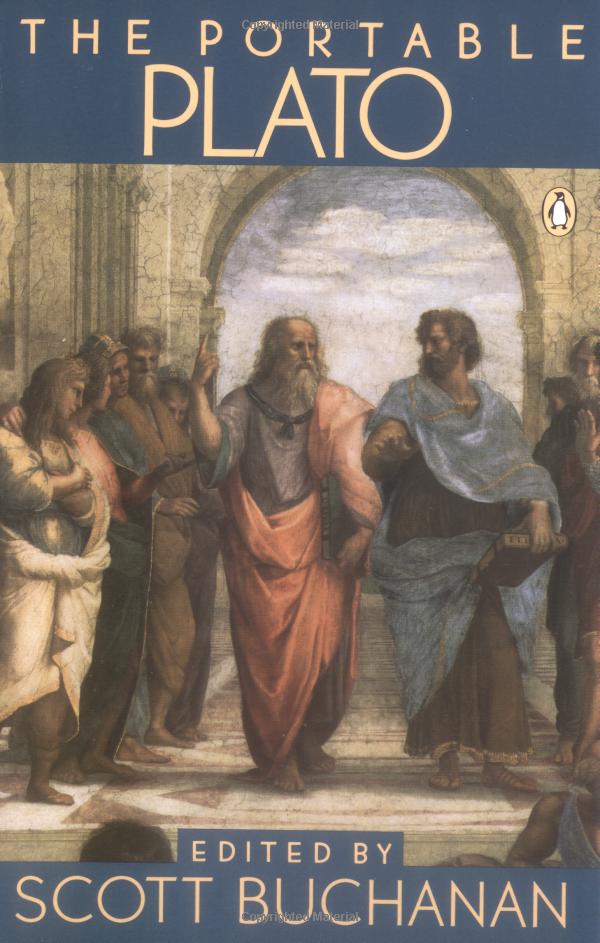
I read the Symposium in seminary almost 20 years ago, and I read the Allegory of the Cave back in high school, but other than that my exposure to Plato has been entirely second- and third-hand. He comes up in Second Temple Judaism in the study of Philo of Alexandria’s works, but not in much else, and I only studied Philo a little. I knew Vezzini’s opinion of Plato, Aristotle and Socrates, but not much else.
The introduction to this edition went on at some length about Plato’s irony. Irony is a tricky thing in a written text, especially an ancient one. As Plato complains in the Phaedrus (not included in this edition), you lose a lot going from a conversation with a live human being to a written text. Without inflection, tone, eyerolls, etc., it can be hard to detect irony in an ancient text… or entirely too easy.
By arguing that an author is being ironic, you can make them mean exactly the opposite of what they seem to mean—or even what they originally did mean. In biblical studies, Ecclesiastes, Job and the Song of Songs come in for this kind of treatment sometimes, because some people can’t bear the thought that these biblical texts can say such, shall we say, unbiblical things.
To take up the theme of contradiction, when two texts of Plato’s are in tension, does this mean that the philosopher didn’t notice the problem; did notice it, and tried to resolve it in favor of the later text (assuming that precedence can be detected); or not only noticed it, but put it in intentionally to put ironic distance between himself and one or both texts? Given the character Socrates’s often playful banter, the last idea cannot be ruled out.
Case in point: the Symposium and the Republic, which occupy most of this volume. Both of these are considered middle dialogues of Plato’s, between his earlier, more playful work and his later, somewhat embittered dialogues. What is the mix of seriousness and play in the middle dialogues? How do the dialogues work internally, and how do they interact with each other?
I claim some expertise with the Hebrew Bible, but when it comes to Plato I’m a rank amateur. Anything I say here is likely to be wrong, and anything I say that’s right has surely been said by someone else somewhere. But Plato’s too good a playground not to take my turn.
The central problem of irony in this volume, I submit, is posed in the Symposium, and in its relationship to the other dialogues here. In it, two associates of Socrates recall a wine-party the master had with some of his friends 15 years earlier—so already we have the problem of accuracy of recall. Moreover, the narrator, Apollodorus, wasn’t at the party, but heard about it from his friend Aristodemus, who was. Apollodorus then followed up with Socrates, who confirmed the account. So we get this dialogue at two or three removes, though also with some triangulation.
Of the other three dialogues in this volume, the Phaedo is narrated by the eponymous eyewitness; the Protagoras is narrated by Socrates himself to an unnamed companion who initiates the conversation; and the Republic is narrated by Socrates to an unnamed, unnarrated, unvoiced companion. Indeed, in lacking an interlocutor, the Republic is in tension with the Phaedrus’s low opinion of writing, because it looks for all the world like a text written by Socrates. So the Symposium and the Republic are already separated by very different modes of transmission, at least in the world of the text.
I’ll need to rehearse the main points of the Symposium. The word “symposium” means a drinking party, but Socrates attends an odd one. Most of the participants had come to Agathon the poet’s house the night before to celebrate his victory in the theater. They drank a ton, and as a result, the next night they are not feeling up to getting drunk again. Eryximachus the doctor suggests that instead they compose spontaneous praises to the god of love (Eros). All agree, and a number of speeches follow. Eventually it comes to the turn of Aristophanes, the comic playwright.
Aristophanes’s play The Clouds includes a caricature of Socrates, but here the two men seem to be perfectly friendly. Aristophanes, rather than a straightforward encomium to Eros, tells a myth. He insists it’s true, but it’s also obvious that no one at the party has heard it before.
The sophist Protagoras tells a myth in the Protagoras, and Socrates ends the Republic with a myth; both these men also insist that their stories are true, despite their obvious unfamiliarity to their companions. Apparently, an accepted tactic in Platonic debate is to make up a myth which nonetheless gets across what you’re trying to say. As we’ll see, Socrates tells another of his own (sort of, maybe) in the Symposium itself.
Aristophanes’s myth is that humans originally were two people joined together: either two men, a man and a woman, or two women. These beings were so powerful they made war against the gods, who retaliated by splitting them up. Now, we are all seeking someone like the one we were split from, or even that very person themselves.
Agathon the prizewinner makes his speech, and then Socrates begins his. He begins with some initial questions in his usual mode of setting the terms of debate, establishing that love is the desire to possess the Beautiful. He then tells a story of his education by Diotima, a woman teacher, on the topic of love.
Diotima begins by explaining to Socrates that, though Love implies a lack of possession and therefore cannot be a perfect god, it is a spirit halfway between gods and humans. She tells her own myth of Love as the child of Plenty and Poverty. She speaks positively about poets as makers and creators inspired by Love. She mentions, offhand, that some people speak about humans as split apart from their original partner, but she says this is false. Instead, she describes how people can go from loving a beautiful person, to loving all beautiful people, to loving Beauty itself (this is the so-called “Ladder of Diotima,” and it’s essential to Christian mysticism, where the final rung of the ladder is God).
When Socrates wraps up, Aristophanes is about to call him on the fact that Diotima, supposedly years ago, knew Aristophanes’s myth of the split-apart. (My mysticism professor, Carmen McKendrick, pointed this out to me.) Shouting at the front door interrupts them, and Alcibiades, a beautiful young man who is madly in love with Socrates, barges in. He is invited to add his own praise of Love, but refuses to praise anyone but Socrates.
Alcibiades’s besotted paean to Socrates the “wonderful monster” may seem off-point, except that he is the only person at the Symposium who actually is in love with someone (Prof. McKendrick again). But does that make his words count for more, or less? Alcibiades does not seem at all like he is able to make his love for Socrates a jumping-off point for contemplation of the Beautiful in itself.
The whole thing ends in chaos as a bunch of drunken revelers break in and force everyone to drink. Everyone gets wasted except Socrates, who early in the morning is heard arguing that the spirit of comedy and the spirit of tragedy are really one. No one can follow his train of thought by that point.
Diotima’s Ladder is the centerpiece of the Symposium. But is it all a joke? Socrates tells one lie when he says Diotima mentioned Aristophanes’s myth; so is the whole Ladder a lie? Is Diotima even real? Earlier scholars argued as much because they couldn’t imagine Socrates being influenced by a woman. This makes me not want to discount Diotima’s reality, but the ironic distance surrounding her is not encouraging.
It gets worse when you compare the Symposium to the Republic. Remember that while the account of the drinking party is at two removes at least, the Republic has Socrates speaking into blank space. Does that mean the Symposium is to be taken less seriously than the Republic? We’d need more to be able to say that.
The Republic is far too long and dense to treat in the same detail here, but we can pull out some threads.
- Socrates, in constructing a hypothetical ideal State, says that the guardians will need to lie frequently to the lower classes to keep them in line, despite also saying that falsehood is the root of evil action.
- Women in the Republic are to be educated just as the men (at least, those judged sufficiently elite mentally), including gymnastic exercises. Is this a sign of Platonic feminism (to grossly abuse that word) that encourages us to believe in Diotima? Or is it ironic, in its obvious offensiveness to Athenian sensibilities, which are lampooned throughout the Republic?
- Socrates speaks dismissively of those who love “sounds and sights” as having minds incapable of apprehending absolute Beauty. He never accords them the possibility of climbing Diotima’s Ladder. People who can appreciate Beauty itself are a completely different sort of person.
- Socrates does permit a ladder of his own, but this one climbs by way of arithmetic and geometry, not love. This is how the absolute realities are taught in the Republic—by way of abstracts, not sensual perceptions. Contrast the Protagoras, where Socrates argues that virtue cannot be taught because absolute Good cannot be taught.
- Love takes another hit when it is said to be the motivating force of a tyrant, the most disordered of people in charge of the most disordered state.
- Whereas Socrates in the Symposium demurred from contradicting the “divine Homer,” here Socrates follows the conclusion of his description of his ideal state by saying that his favorite part is the prohibition of “mimetic poets” like Homer and Hesiod.
- This survey of tensions between the Republic and the Symposium increases the ironic tension between the two dialogues. However, does the tension rise to the level of a contradiction requiring us choose one? Or do we need to hold both poles in our heads?
- A different tension occurs in the final portion of the Republic, which considers the immortality of the soul, a topic absent from the Symposium but central to the Phaedo. There, as he is about to drink the hemlock, Socrates argues that the soul brings life to the body, and as such the soul can never receive death, and is thus immortal. In the Republic, Socrates argues more simply that the soul, not being subject to occurrence in degrees but only in itself, is impervious to evil and therefore immortal.
- Seeming to feel the weakness of the argument, Socrates concludes by telling the so-called “Myth of Er,” about a man who died, went to the underworld, then returned to tell what it was like. Like all the myth-tellers in the dialogues, Socrates insists on its truth, while not lifting the sense of spontaneity and fabrication from the story. Does this put an ironic distance between us and the immortality of the soul, a central Platonic belief? Is, in the end, nothing sacred?
It will take a lot more reading and thought about Plato to come to any sense of certainty about these matters, however illusory and fleeting. But it does seem to me to say something about biblical contradictions. The editors of the biblical texts knew full well what they were doing. They preserved contrary versions of their stories in the form of a story which only seems singular at first glance. Their tolerance for contradiction had its limits, as the various editorial interventions showed. And sometimes we who come after then have to make a choice about how we will read these texts. I have only begun to build a habit of reading Plato. How will our habits of reading authoritative texts change, as we discover the tensions within and between them?
 Stewart Moore: Stories
Leave a comment