
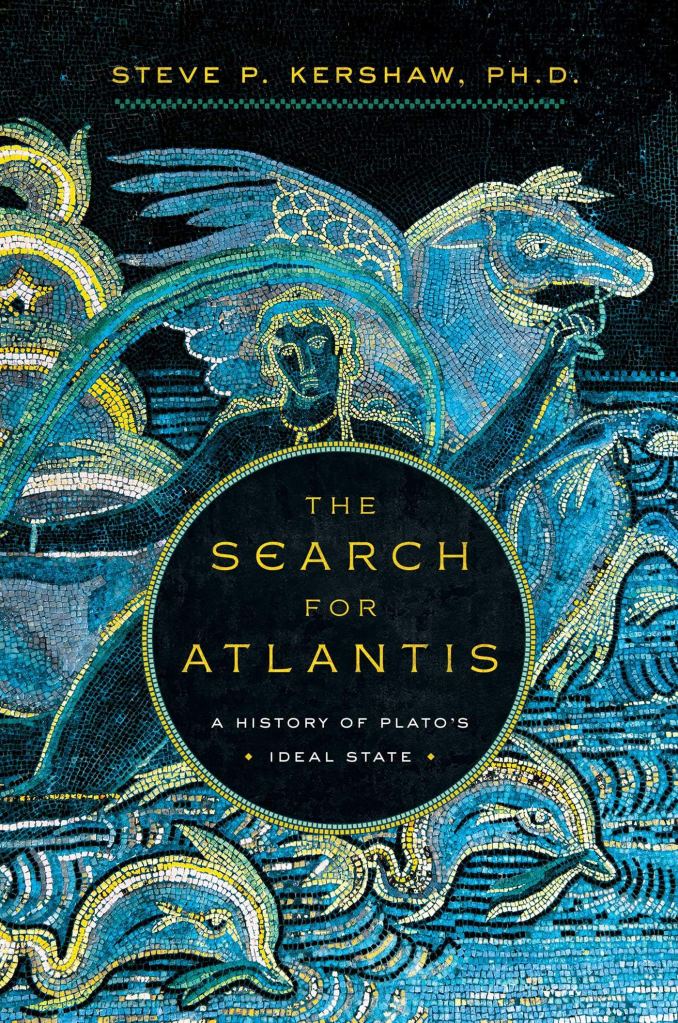
Steve P. Kershaw, The Search for Atlantis: A History of Plato’s Ideal State (New York: Pegasus Books, 2018).
This is a rollicking account of Atlantis from its forebears in other mythical islands of the Greeks, to its source in two dialogues of Plato (the Timaeus and the Critias), through many of the speculations that have taken the name of Atlantis as their jumping-off point. Some of the kookier modern theories were familiar to me, many were not, and all were enjoyable to read about. I was especially struck by the observation that Atlantis is not Plato’s perfect state; that laurel goes to its enemy, proto-Athens of 9600 BCE, which clearly embodies the ideals of Plato’s Republic.
So having enjoyed this book so much, I’m going to lean on one significant tension. Kershaw begins and ends by citing the anthropologist Claude Lévi-Strauss’s dictum that myths are “good to think with.” It’s certainly a safe enough move in the world of the humanities. It implies that unusual thought materials like myths—unusual in the specific sense that they are incompatible with a Western scientific viewpoint—should still be positively valued culturally.
It’s no use, really, running down someone’s myths just for being unWestern; in the ancient world it’s anachronistic, and in the modern world the disconnect is often precisely the point. You can’t preserve a distinctive worldview in the face of Western assimilation without drawing it in contrast to the Western worldview.
Of course, the Western worldview is not a monolithic block, either. It’s almost entirely Westerners, after all, who speculate about Atlantis. But something bothers Kershaw about these modern authors. It’s like one of Plato’s excluded middles, where a naïve interlocutor fails to notice that in between two extremes is a third term. For example, in between knowledge and falsehood is right opinion: when you believe something that turns out to be correct, but you can’t properly justify your belief (from the Meno).
Kershaw constructs a similar excluded middle, but does it backwards as compared to Plato. Instead of the extremes being bad and the moderate middle being good, it’s the other way around. For Kershaw, there is science, which is good (though contingent and constantly liable to revision); and there is myth, which is also good (in this book, a category reserved mostly for ancient writers on Atlantis). In between them is pseudoscience, which is very very bad.
Pseudoscience here is the use of certain rhetorical postures. Among them are the unfalsifiable hypothesis which makes no prediction and therefore cannot be disproved; the stacking of hypotheses to disguise their provisional nature (“If A is so, then B is also so, and then also C…”); the demonization of professional scientists (the accusation that “they” don’t want you to know the truth, without needing to provide a motivation for “their” obscurantism); and so on. Pseudoscience hunts anomalies that feel like outliers to the ordinary, then connects them in a chain. There is no semblance of a scientific process, just the rhetorical joining of “if” to “then” until vast webs of conspiracy are woven.
Pseudoscience certainly has many demonic consequences. But it is nothing if not “good to think with.” Kershaw seems not to notice this; in fact, at the very point that he excoriates pseudoscience, he goes off on a brief rant about cultural relativism, that bugaboo of modernists. Relativism posits that beliefs should be categorized culturally, not scientifically. Relativists note (correctly) that Western science has its own cultural location and its own agendas. For Kershaw, science appears to have an abstract location, just like knowledge, somewhere in Plato’s World of Ideas. It is immune to criticism (though not, in our imperfect corporeal apprehension of it, immune to revision). Science is not merely “good to think with”; it is Good.
The danger here is not in making the ethical decision that pseudoscience is bad. Making that judgment is essential, but not sufficient, for right action. The danger is in submerging how you are making that ethical decision, and upon whom.
In saying that one group of people who believes something at variance with science is merely using something that is “good to think with,” while another is doing a dangerous non-Good action, you are distinguishing them on the basis of what each group does with their beliefs. In his discussion of Nazi appropriations of Atlantis, he makes this explicit: “those who can make you believe absurdities, can make you commit atrocities.”
The logical connection here is extremely weak. There was so much more going on in Nazi Germany than Atlantis, that led ordinary people to wipe millions of their neighbors off the face of the earth. American Atlantis-believers do not seem about to unite in a fascist party with an outline of Atlantis on its flag. However, American fascism does owe a crucial debt to pseudoscience, in that this is a game anyone can play, while not everyone can be a scientist. Mobocracy and the lowest common denominator are central to fascism.
But pseudoscience is not only indulged in by fascists. Liberation movements are often bottom-up enterprises led by people not trained as scientists, arrayed against class warriors who often are educated in scientific economics. Liberationists thus have also had recourse to pseudoscience. Real science has been used against them as a weapon by professional practitioners. Those professionals may have been performing impeccable scientific procedures, but that doesn’t mean they were doing good.
Lévi-Strauss’s saying that myths “are good to think with” is generally taken as a permissive attitude to other people believing other things, of living and letting live. The laissez-faire ethics of cultural relativism lead, and bleed, all too easily into inaction. Making ethical decisions is essential. Naming evil is essential. But it is also essential, in a “scientific” spirit, that those decisions be open and explicit.
Kershaw’s attack on pseudoscience would sweep very different people into one category (fascists and liberationists), because he leaves his decision unstated. As such, it amounts to, “I like these people. They are like me. They are thinking well.” And, “I do not like these other people. They are not like me. They are not thinking well.”
Fighting pseudoscience itself is like declaring war on terrorism. You can declare war on specific terrorists, and potentially even win, but terrorism itself is not a movement. It’s a method. The same goes for pseudoscience. It matters, crucially, who is using the method, how they are using it, against whom and why.
(Does this leave open the possibility of a “good terrorist”? Modern terrorism seems to me to be based on a combination of imperialist ideologies no less repressive that those they oppose, and a failure to apprehend who your real enemies are and how complicated the situation is. But perhaps there are examples from the past that faced a simpler moral calculus. Does Native American resistance to European/American colonization fit the bill? How about local resistance to the Nazis during WWII?)
The targets of Kershaw’s attacks seem to have one thing in common: they are Westerners who, in his estimation, should have known better. They are failed Westerners, in that they have failed to take on Enlightenment scientific values. People who precede the Enlightenment are excused; they are permitted to think with whatever they like. Kershaw has no examples of non-Western Atlantis speculation, and there may not, in fact, be much before very recently. One wonders whether he would permit its practitioners space to choose what is good for them to think with, and then judge them by the fruits of their actions, not the soil in which they are sown.
 Stewart Moore: Stories
Leave a comment