
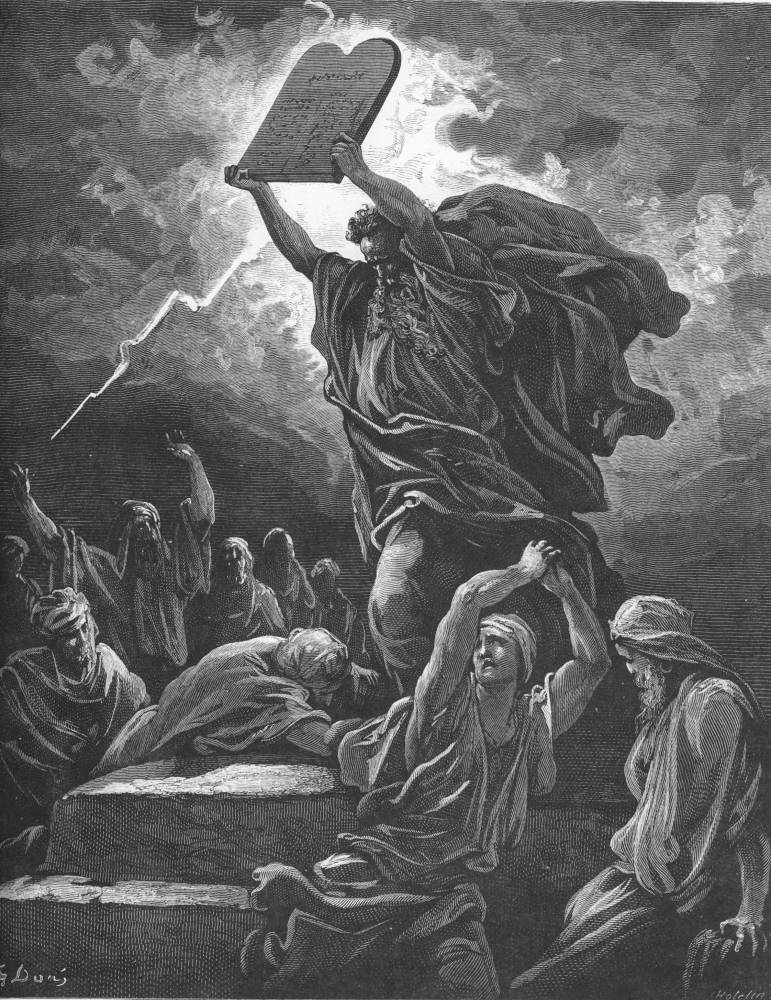
Today’s biblical contradiction involves the Ten Commandments, so you know it’s juicy. In fact, it’s “juicy” in more ways than one.
The Second Commandment reads:
You shall not make for yourself an idol, whether in the form of anything that is in heaven above, or that is in the earth beneath, or that is in the water under the earth. You shall not bow down to them or worship them; for I the Lord your God am a jealous God, punishing children for the iniquity of the parents, to the third and fourth generation of those who reject me, but showing steadfast love to the thousandth generation of those who love me and keep my commandments. (Exodus 20:4-6, NRSV)
It’s a troubling notion, God punishing the great-grandchildren of people who displease Him, not least because it’s repeated three more times (Exod. 34:7, Num. 14:18, Deut. 5:9). Most of the websites of biblical literalists I checked for this contradiction soften the meaning. For them, God does not personally and deliberately punish the (great)(grand)children of sinners; rather, a parent’s bad decisions affect the next generation(s). That, of course, is true enough; but is that what Exodus means?
The crucial words are “punishing children for the iniquity for the parents.” The Hebrew is poqed awon abot al-banim. Poqed is the present participle of pqd, a root that has a wide number of meanings. It can mean simply “to pay attention to,” as well as “to visit upon” (an archaic construction the Brown-Driver-Briggs Hebrew Dictionary parses as “punish”), or “to muster, number or appoint.” To decide which to apply (if any of these), we need to understand the rest of the phrase.
Awon abot is a possessive construction meaning “parents’ iniquity” or, by extension, “parents’ punishment.” It is indefinite; there is no “the” in the Hebrew here. “To pay attention to parents’ iniquity” sounds like a possible understanding so far, and would support the evangelical reading.
However, the final part of the phase, al-banim, means “upon children.” “To pay attention to fathers’ iniquity upon children” sounds in English like it could mean that God is merely recording the bad things the parents are doing to their children. However, there is not one attested use of the preposition awon al- that means “iniquity that someone committed against someone else.” In fact, there is only one use of these two Hebrew words together, in 2 Samuel 14:9, and it clearly means, “Let the iniquity/punishment be on me.”
So let’s go back. “Muster” or “number” make no sense of poqed here, so we are left with the commonly attested meanings “visit upon” (which has the virtue of including the preposition al) or “appoint.” Really, either one will work. The sense would be that God takes the iniquity/punishment of the parents in hand, and assigns them to the (great)(grand)children.
The action is deliberate on God’s part: the children would not naturally suffer for the awon of their parents, without God’s conscious action. This rules out the soft meaning of this phrase, and leaves us with the very difficult concept that God does bad things to children who have not themselves done anything to deserve them.
And this is where the contradiction comes in, because not one but two biblical authors also thought this idea was terrible.
In those days, they shall no longer say, “The parents have eaten sour grapes, and the children’s teeth are set on edge.” But all shall die for their own sins; the teeth of everyone who eats sour grapes shall be set on edge. (Jeremiah 31:29-30, NRSV)
What do you mean by repeating this proverb concerning the land of Israel, “The parents have eaten sour grapes, and the children’s teeth are set on edge”? As I live, says the Lord God, this proverb shall no more be used by you in Israel. Know that all lives are mine; the life of the parent as well as the life of the child is mine: it is only the person who sins that shall die. (Ezekiel 18:2-4, NRSV)
The saying about the sour grapes was apparently current in Jeremiah and Ezekiel’s time, between when Babylon had kidnapped the wealthy and artisan classes from Jerusalem in 597 BCE, and when Babylon destroyed Jerusalem in 587 BCE. It was used in the same sense as the language of the Second Commandment: God punishes the descendants of those who did the actual sinning.
Both Jeremiah and Ezekiel seem offended at how their own generation uses this proverb. The two prophets say, quite simply, “God doesn’t do that sort of thing at all”–despite the clear terms of the Second Commandment. It is possible to read Jeremiah’s version as referring only to a future state, but Ezekiel’s remains stubbornly present tense. Indeed, the entirety of Ezekiel 18 is a point-by-point refutation of the entire concept of generational punishment.
So the Second Commandment clearly says that descendants are punished, whether or not they have done anything wrong, while Jeremiah and Ezekiel clearly say that that is nonsense. Maybe the passages from these prophets should be posted next to every poster of the Ten Commandments in any classroom. Or was encouraging rational thought not the point of those posters?


Leave a comment